
That Old Black Magick...
Resisting the Limitations of Social Stigma

Before I begin, I am taking the audience to be reflective adults, already comfortable with myth, religion, and the limits of modern moral language. I am grounding the discussion in Germanic and Norse lineage without turning it into reconstructionism, and I treat wound-world metaphysics as a lived model rather than a belief system.
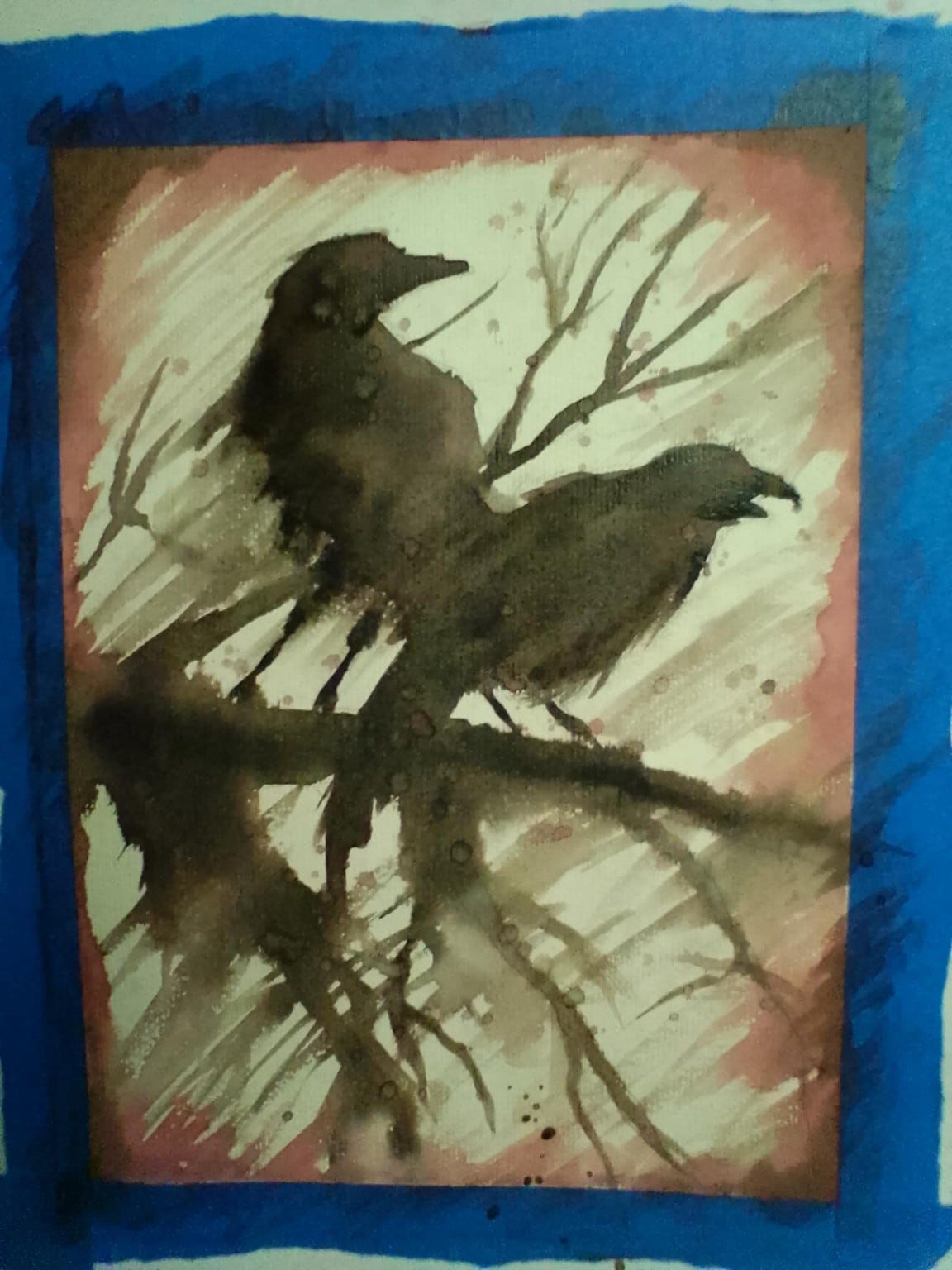
Cover by David Lawson. Lawson is an artist and musician from Illinois whose work delves into the dark, liminal spaces of the psyche and ancient ancestral connections. You can see more of his work at Dave's Facebook and you can hear his music at The Homicidal Hillbilly
The first thing a body learns about the world is pressure. Long before language, long before doctrine, there is weight on skin, pressure in the lungs, hunger in the gut, heat in the blood. The world announces itself by contact, and that contact is rarely gentle. Life begins as friction, and meaning grows out of repeated encounters with resistance. A wound is simply one of the ways the world teaches.
What modern discourse often calls dark magick begins at this same point of contact. It is not born from inversion or rebellion, but from intimacy with processes that polite metaphysics prefers to keep abstract. Decay feeds soil. Predation shapes ecosystems. Pain sharpens attention. These are observations, descriptions of how matter and life organize themselves over time. In the wound-world model, metaphysics begins where biology and myth overlap, where the body recognizes patterns older than ethics and deeper than preference.
Germanic and Norse sources do not present the cosmos as a moral classroom, or an illusion to work off the debt of other illusions. Here, the cosmos is a living system held together by tension. Yggdrasil stands because it is fed by rot, watered by wells that demand sacrifice, gnawed by beasts at root and leaf, and constantly strained by opposing forces. The tree survives because it is wounded continuously and adapts to that wounding.
Odin’s central act is self-inflicted damage undertaken for knowledge. He hangs himself on the tree, pierced and starving, not as a symbol of martyrdom but as a practical engagement with the structure of reality. He does not ask the runes to reveal themselves; he subjects his body to conditions under which revelation becomes unavoidable. Knowledge arrives when the nervous system is stripped of comfort and forced to reorganize. The wound produces the alphabet of fate.
This pattern recurs throughout the lore. Tyr loses his hand to bind a force that threatens the order of gods and humans alike. The loss is not framed as tragedy or triumph. It is an exchange. Freyja moves freely between love and slaughter, fertility and death, without apology or explanation. Hel governs a realm neither punitive nor redemptive, simply final and necessary, she herself half living and half dead. These figures operate according to a logic of function rather than virtue. They embody forces that keep the world moving, when movement hurts and the final destination is one’s own certain doom. This is the stark, grim lore of the Germanic cosmos.
Wound-world metaphysics takes this logic seriously. It begins from the premise that reality responds to engagement, not belief. The world does not care whether an act is framed as light or dark; it responds to pressure, attention, repetition, and sacrifice. Ritual works when it alters the practitioner’s relationship to these variables, not when it satisfies a moral narrative. A cut focuses the mind because blood changes priorities. Breath changes chemistry. Desire reorganizes behavior. Magick works under the same principles as physical phenomena.
The language of good and evil struggles to describe these processes because it evolved to regulate social behavior, not to map cosmological mechanics. When applied to magick, it often functions as a brake rather than a guide. The wound-world model treats morality as a local adaptation rather than a universal law. It matters within communities. It loses coherence when projected onto the structure of existence itself. Storms, plagues, and fertility do not choose sides. They respond to conditions.
Dark magick, in this frame, is simply magick that refuses to lie about its ingredients. It acknowledges that power flows through hunger, fear, sex, death, and domination because those forces already move through every living system. Refusing to engage them does not neutralize them, it only cedes agency to unconscious patterns. The path treats conscious engagement as a form of responsibility, not indulgence.
The body becomes central here because the body cannot abstract itself out of consequence. A person who works with blood understands limits immediately. A person who works with breath learns timing. A person who works with pain learns calibration. These practices produce knowledge that cannot be acquired through belief alone. They force feedback. The world answers quickly when flesh is involved.
This is why wound-world metaphysics insists on practice rather than doctrine. An idea that does not change posture, respiration, sleep, appetite, or attention remains decorative. Odin’s wisdom costs him an eye because vision changes when depth perception is altered permanently. Tyr’s justice costs him a hand because binding requires leverage. Even the gods were aware that great power only comes at great cost.
A blade cuts regardless of intent. Poison transforms regardless of narrative. Fire consumes according to chemistry, not ethics. When magick aligns itself with these principles, it stops demanding permission from imagined authorities and begins negotiating directly with forces that can answer back. The negotiation is often uncomfortable. It is also precise.
Modern practitioners often inherit moral frameworks that were designed to discourage agency among populations rather than to cultivate discernment among individuals. Wound-world metaphysics relocates ethics, rather than removing ethics wholesale. Responsibility becomes internal rather than external. Consequence replaces prohibition. The question shifts from whether an act is permitted to whether one is prepared to carry its effects through time.
This relocation mirrors older patterns of initiation. In many Northern contexts, adulthood was marked not by passage of time but by demonstrated endurance, oath-keeping, and the capacity to survive hardship without fragmenting. A person’s reputation carried on after their death, possibly for generations. Reliability mattered because unreliable people endangered kin and land. Reliability arose from familiarity with fear, pain, and desire, not from denial of them.
The wound in wound-world metaphysics is not a fetishist hashtag. A wound reveals structure. It shows where something gives way under pressure. It marks thresholds. Scar tissue tells a story about adaptation. A mind that has never been challenged remains brittle. A spiritual system that avoids damage cannot respond when damage arrives uninvited.
Ritualized engagement with wounding forces differs from trauma because it preserves agency and timing. The initiate chooses when to enter the crucible, sets boundaries, and integrates the outcome into a coherent narrative of self. This distinction matters. Wound-world work aims to produce density, not fragmentation. The body is stressed to increase load-bearing capacity, not to shatter.
The Norse imagination understood this intuitively. Fate, or wyrd, was not destiny handed down by moral judges. It was the accumulated consequence of actions interacting across generations. Blood remembered because behavior echoed. The dead mattered because patterns persisted. Working with ancestors meant acknowledging inherited tendencies toward violence, loyalty, hunger, and care.
Within this framework, the relationship between human and god becomes collaborative, rather than submissive. Engaging them requires offering something of equal weight. Odin listens because the practitioner mirrors his willingness to risk loss for insight. Freyja answers because desire is taken seriously as a shaping force rather than a distraction.
Wound-world metaphysics reframes the sacred as something that bleeds. Holiness becomes intensity of contact rather than separation from matter. A shrine is any place where attention, risk, and repetition converge. A body under strain qualifies. A battlefield qualifies. A birthing bed qualifies. These sites are sacred because thresholds thin there. The world responds more quickly when stakes are real.
The insistence on neutrality often unsettles readers trained to equate darkness with malice. Yet malice requires intent to harm for its own sake. Most dark magick concerns itself with survival, autonomy, and transformation under constraint. It recognizes that ecosystems do not optimize for comfort. They optimize for resilience. Resilience emerges from exposure, not insulation.
When a practitioner adopts this view, their work becomes quieter and more exacting. There is less need to justify actions through ideology. Results matter more than rhetoric. Signs appear in sleep, appetite, luck, and the behavior of others. The world signals alignment or resistance without commentary.
The wound-world model does not promise salvation. It offers an initiatory framework to traumatic events. It suggests that meaning arises through participation in forces larger than the self, approached without sentimentality. It asks whether a person can stand inside their own fear without fleeing, whether they can desire without dissolving, whether they can cut without losing precision. These capacities determine effectiveness more reliably than moral stance.
As the practitioner deepens, the distinction between inner and outer world becomes less useful. Emotions feel like weather systems. Thoughts acquire weight. The body registers shifts before language catches up. This sensitivity is mystical, spiritual, neurological. Attention trained through ritual reorganizes perception. The wound teaches where to look.
Norse myth ends without redemption. Ragnarök arrives because cycles complete. Gods die because forces exhaust themselves. A new world emerges from the old without apology. Some call this a pessimistic worldview, but I have always found it to be more pragmatic. Individual lives matter because they participate in continuity, not because they escape it. Magick aligned with this vision does not seek to transcend the world, it seeks to meet it without flinching.
Wound-world metaphysics therefore remains unfinished by design. Each practitioner extends it through their own scars, failures, and adaptations. The model does not close with a moral. The question it leaves hanging is not whether darkness can be justified, but how much reality one is willing to touch directly, and what kind of person emerges when the touch leaves a mark.
[My work is built on reciprocity. Public words remain open. The more personal writings are gifted to those who support with $5 monthly. If that is out of reach, send me a message and I will still share those texts with you.]
I find it interesting that in the twilight of Abrahamism the notion that directs a functioning morality is rejected. I write this with the full awareness that Abrahamism arose as a thief and competitor, and owed its ascendency to temporal forces.
The purpose of a working morality is to allow the florescence of the person, and we must admit, if we are honest, that almost all of the spiritual life of the ancestors is not included in the record. We have only the broken testimony of Runestones and talismans to jog our memories, and perhaps a few accounts by enemies who recorded such for their own purposes.
This is not written as an indictment or a criticism, it is merely an observation that for certain ancient customs to be important, such as marriage and the function of the caste system, loyalty and love, there was of necessity a form of morality in place.
Magic without morality must I think, answer questions regarding aim and purpose.
A final observation, and one that troubles me, is the gift of Abrahamism that intentionally destroys any place for spirituality.
Just to be clear, I am not critiquing your work. These are merely the honest responses i find that arise from reading this worthy post.
"A wound reveals structure" could sit as an epigraph over most of what I write. I just published a piece about a Roman torturer who prepares a floor of broken pottery with the care of a tiler; the craft of wounding as diagnostic, not spectacle. Your wound-world frame gives it a name I hadn't found. The parallel with Odin's self-inflicted damage as practical engagement rather than martyrdom is particularly sharp. There's a version of Mediterranean Catholicism that understood this too, before it got sanitized.