

Heroin Saint
A Tale From the Wound-World

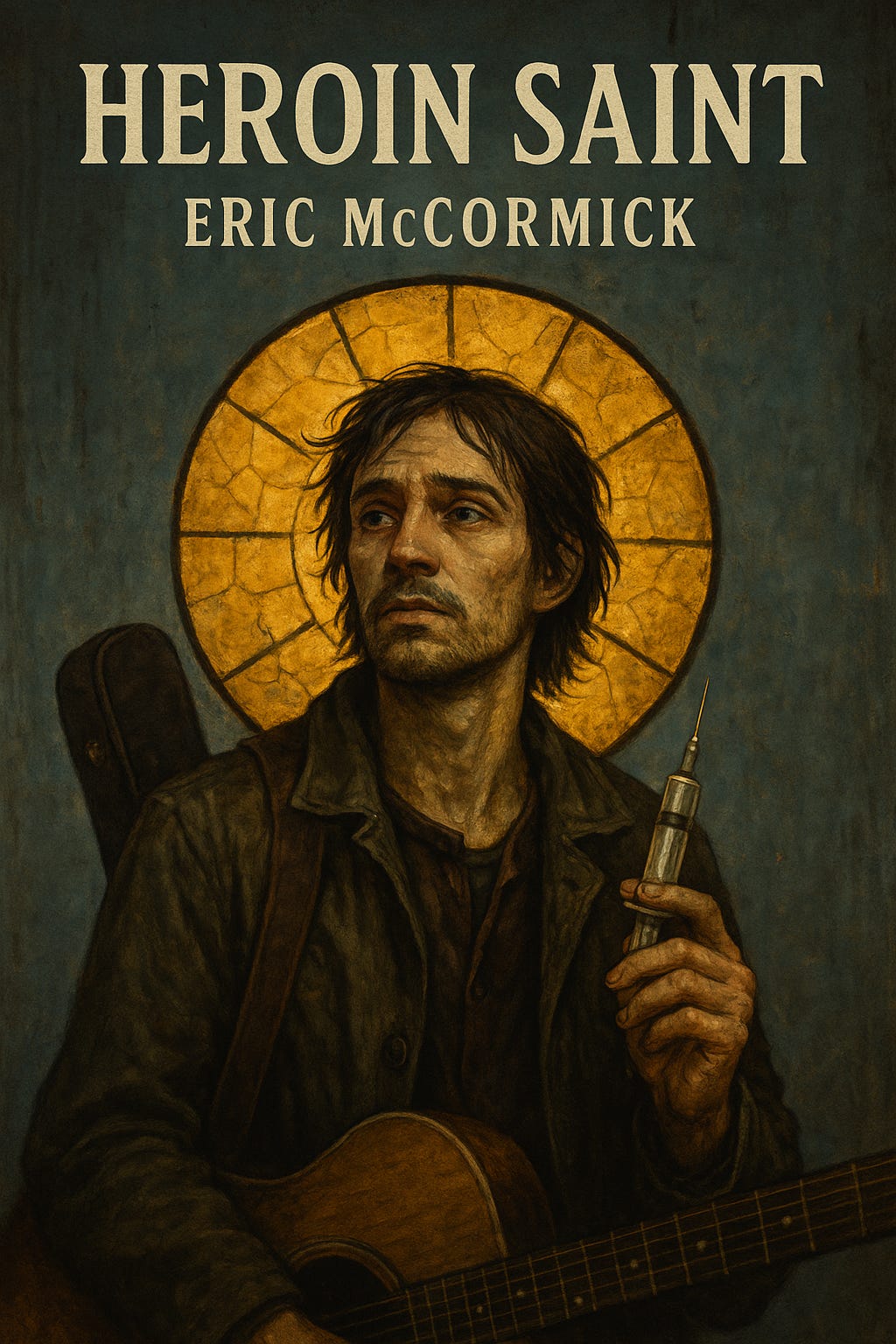
Heroin Saint
The Greyhound coughed into the station, brakes bleeding air and brake dust into winter rain. Jay stepped down with his guitar on his back, duffel hanging low on his hip. Laundromat soap clung to the fabric. Alley sleep clung to him.
He passed a flickering vending machine. The concourse smelled of wet coats and stale puddles. A boy in a varsity jacket filmed his girlfriend biting into a fry. Jay counted his bills slow, like a priest fingering beads. Enough for a bed. Enough for a hit. Maybe food, if he played first.
He found the far corner of the station, where the tiles hid puke and the acoustics were forgiving. The E string sighed into tune. He started a song about rivers and fences and a Missouri fire. His voice scraped and smoked. Coins rang on the tile. Two teenagers filmed fifteen seconds of him they’d forget by morning.
Near the busted change machine, a woman in yellow stood watching. Fluorescent light crawled down her dress; cowrie shells rested at her throat. A sprig of basil poked from her denim pocket; Jay had a wild idea that the basil had grown there.
He finished a verse. She moved a little closer. A paper cup steamed in one hand, a small bag sweated grease in the other.
“You sound like an oath someone forgot to keep,” she said.
Jay kept his face blank. “Oaths don’t buy noodles.” He nodded at the cup. “Trade you a song for a sip.”
She handed him the bag instead. The crust cracked under his teeth, cumin and something sweet blooming in his mouth.
“Your second fret buzzes,” she said. “You bend to hide it. You hide it well.”
“I bend because it hurts if I don’t.”
She touched her shells. “I’m Lía. Saints in my pockets, crossroads in my eyes. This city grows on those.”
The mint tin in his guitar case began to hum, low and mean, copper flooding his gums. He shifted closer to the case.
“You look cold,” she said. “Come with me. There’s a café that serves coffee like a sacrament and charges like a sin. The owner lets me bring in the outside world.”
“You always talk like that?”
“Yes.”
They stepped into the rain. Silver threads stitched the street. A truck hacked at a red light. The café wore a mural of saints in sneakers. Inside, light Latin music skipped around the corners. Lía greeted the barista in Spanish. The barista waved them to a corner booth, where the wallpaper curled like old leaves.
She set two cups, a glass of water, and a dish of sugar between them. She mounded the sugar, stabbed it with a spoon.
“You run hot in the voice,” she said. “Cold in the blood.”
“I run on what I can.” He sipped coffee until it burned. Pain told the truth.
She stirred hers slow. “I don’t care what you use. I care what uses you.”
His shoulders tightened. He didn’t touch the case.
“Everyone feeds,” she said. “Some feed neat. Some feed messy. Some feed with mouths. Some with songs. Hunger’s not the problem. It’s what grows near the dish.”
He studied her hands. Small scars ran across the knuckles, a tiny key tattoo on her wrist. “What’s your game?”
“I find people already chosen by a road. I teach them to walk without getting eaten. You can pay with a song, in a place I’ll show you.”
The tin in the case throbbed. He glanced at her scars again. “What kind of road?”
“One that doesn’t care if you believe in it. One that smells like wet earth even when the city’s bone dry. One that remembers your first promise and your last lie. You already feed it every time you play. I can show you how to feed back.”
Jay swallowed. “Where?”
She smiled like a lock turning. “Downtown. A place with old bones under new paint.”
They walked. Rain softened. The city exhaled. A bodega waited between shuttered storefronts. She bought rum, cigars, brown sugar, tucked them into her tote like offerings.
“You a priest?” he asked at the crosswalk.
“A daughter. A hand. A listener. Call it Santería if you need to.”
•••
The stairwell smelled of warm paint and wet carpet. She unlocked the third floor with a gold key. Inside: saints with chipped faces, bowls of water, a rum glass with a straw, coins in a dish, candy wrapped in red paper.
“Leave the guitar in the case,” she said. “Some like silence first.”
He obeyed. She handed him water. “We’ll talk plain. Nothing touches you without my say. If it tries, I break its fingers.”
They sat. She asked about his past, his guitar, when pain became proof. He answered with bones, not flesh. She listened without leaning in.
When he finished, she lit a cigar at the altar, let the smoke coil. She dropped sugar into the air.
“You brought a friend,” she said. “Not the one in the tin. The one in your notes, in your wrists.”
Jay’s mind pulled up nights when songs opened something in the air, when his lungs tasted of iron after the last chord.
“What is it?”
“A feeder. Eats feeling, old hope, promises in pieces. Keeps you alive when you burn too hard. Everything has a bill.”
“Installments?”
“You can farm it. Or let it graze.”
She pulled a small mirror from a drawer. The glass rippled, dark and slick. She set basil, sugared rum, and two coins before it.
The curtains stirred. The ripple deepened into a mouth-shaped shadow.
“Look at it,” she said.
He held the gaze. The throat beyond rippled like a riverbed. The air thickened with the scent of rain on iron.
“This is Bruise now,” she said. “It’ll answer to that while it eats here. You’ll feed it right. You’ll take sugar for the road-keepers. You’ll eat from the ground, not just the needle. I’ll cut you free from hungers that aren’t yours.”
Jay picked up the warm coin she slid to him.
“And the tin?” he asked.
“That’s a tool that pretends it’s a master. Let me take the part that lies. You keep the rest.”
He pictured motel bathrooms, blue mirrors, and the relief after the plunge. “Take a little.”
She set bread before the crossroads figure, dripped water on the tin, opened it. The air thickened. The water in the glass arched as if licked. Jay’s hunger dropped to embers.
“Play,” she said.
He lifted the guitar. His fingers met the strings like an old friend. A simple progression, soft nonsense syllables. The mouth in the mirror eased shut. The room smelled of sugar and rain.
“You’ll come back in three days,” she said. “We’ll walk the skin under the skin.”
•••
Jay left with the coin warm in his pocket, basil and rum on his breath. Rain misted the streetlights into halos. The bus at the curb rumbled, windows tired eyes on the city. He didn’t board.
The night tasted metallic, like something listening under the sidewalk. He touched the coin. It answered.
He walked.
Thank you so, so much. I truly do appreciate your kind words, and look forward to the podcast tomorrow. It really means a lot that my writing connected with you.
This piece was selected for a shout out on my podcast tomorrow, so I'll share more then, but I had to leave a comment as well. You have a wildly unique and distinct writing style that I find insanely captivating. The dialogue in particular is both poetic and surreal.
The storytelling is human and grounded, but also deeply profound. This was an incredible reading experience.